


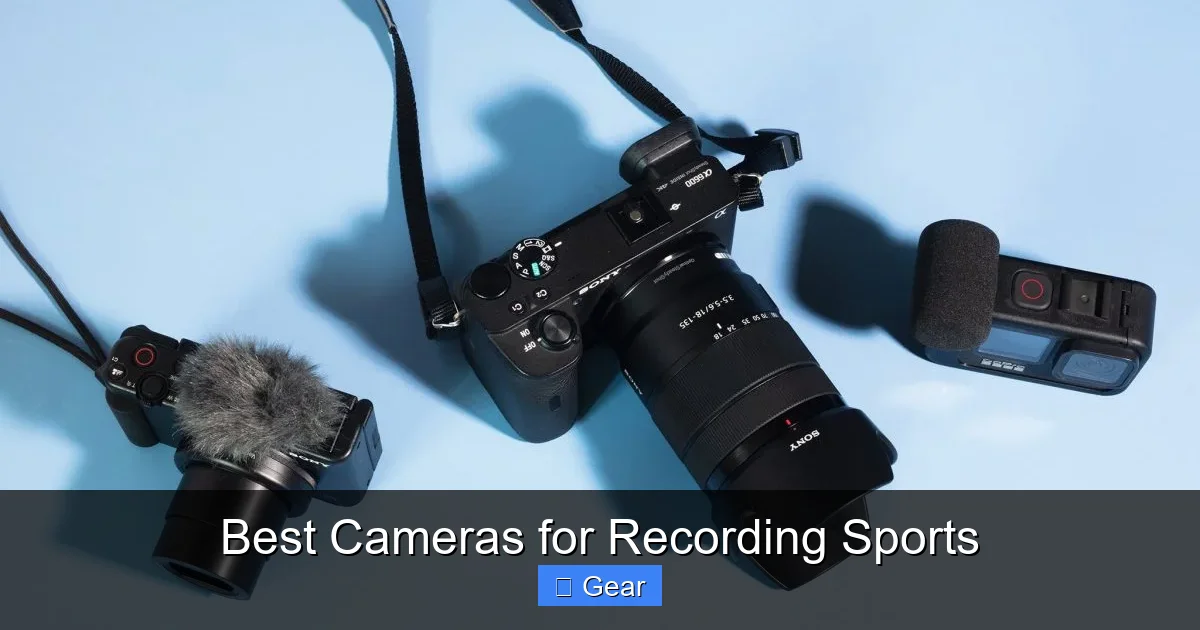
Capturing exhilarating sports moments demands specialized gear. This guide helps you find the best cameras for recording sports, focusing on crucial features like lightning-fast autofocus, high frame rates, and excellent image stabilization. We explore various camera types and recommend specific models to ensure you never miss a shot, delivering crisp, professional-quality footage every time.
Hey there, fellow sports enthusiast and aspiring videographer! Have you ever found yourself at a game, witnessing an incredible play, and wishing you could capture it with the kind of crisp, detailed footage you see on TV? Or maybe you’re a coach looking to analyze player performance, a parent wanting to immortalize your child’s sporting achievements, or a content creator aiming to produce thrilling sports highlights. Whatever your motivation, the challenge is real: sports are fast, unpredictable, and often happen far away or in tricky lighting conditions.
Picking the right gear is the first and most crucial step towards success. You can’t just grab any old camera and expect professional results. The demands of sports videography require specialized features designed to keep up with the action, ensure clarity, and deliver stunning visuals. That’s exactly why we’re diving deep into the world of the best cameras for recording sports today. We’re going to break down what truly matters, look at different camera types, and even suggest some specific models that excel in this demanding field.
So, get ready to explore the exciting possibilities that modern camera technology offers. By the end of this guide, you’ll have a clear understanding of what makes a camera truly great for sports, and you’ll be well-equipped to make an informed decision that will elevate your sports recording game to a whole new level. Let’s get into it and find your perfect match!
Key Takeaways
- Autofocus Speed is Paramount: For fast-moving subjects, a camera’s autofocus system must be quick, accurate, and capable of tracking action across the frame to keep athletes sharp.
- High Frame Rates (FPS) are Essential: Recording at 60fps, 120fps, or even higher allows for smooth slow-motion playback, crucial for analyzing plays or showcasing epic moments with dramatic flair.
- Image Stabilization Matters: Whether optical (OIS) or in-body (IBIS), good stabilization helps counteract camera shake, especially when shooting handheld or with long telephoto lenses, resulting in steady, professional-looking footage.
- Sensor Size and Low-Light Performance: Larger sensors (APS-C, Full-Frame) generally offer better image quality, dynamic range, and superior performance in challenging low-light conditions like indoor arenas or evening games.
- Battery Life and Durability: Sports shoots can be long and demanding; a camera with excellent battery life and a robust, weather-sealed build is vital for uninterrupted recording in diverse environments.
- Lens Choice is Crucial: Beyond the camera body, the right lens—often a fast telephoto zoom—is indispensable for getting close to the action and achieving that coveted blurred background effect.
Quick Answers to Common Questions
What’s the most important feature for sports cameras?
Lightning-fast and accurate autofocus with excellent tracking capabilities is the most crucial feature, ensuring your fast-moving subjects remain sharp and in focus.
Do I need 4K video for recording sports?
While not strictly essential for all uses, 4K video provides much more detail, allowing for cropping in post-production without significant loss of quality, and future-proofs your footage.
Are action cameras good for all types of sports recording?
Action cameras like GoPros are excellent for extreme sports, unique perspectives, and rugged environments due to their compact size and durability, but they typically lack the zoom and low-light performance of larger mirrorless or DSLR cameras for distant action.
What type of lens is best for sports?
A fast telephoto zoom lens (e.g., 70-200mm f/2.8 or 100-400mm) is generally considered the best for sports, allowing you to get close to the action from a distance and isolate your subject with a blurred background.
How can I make my sports footage look less shaky?
Utilize cameras and lenses with good image stabilization (IBIS and OIS), shoot with a high shutter speed, and use a tripod or monopod for added stability, especially with long lenses.
📑 Table of Contents
What Makes a Camera Great for Recording Sports?
When it comes to capturing the lightning-fast, often chaotic world of sports, not all cameras are created equal. The “best cameras for recording sports” share a core set of features that are absolutely non-negotiable. These aren’t just nice-to-haves; they are fundamental to getting usable, high-quality footage.
Blazing-Fast and Accurate Autofocus (AF)
This is arguably the most critical feature for sports. Athletes move quickly and often change direction unexpectedly. A camera with slow or unreliable autofocus will result in blurry, out-of-focus footage, rendering even the most epic moments useless. Look for cameras with advanced AF systems that boast a high number of AF points, wide AF coverage across the frame, and sophisticated tracking capabilities (like subject recognition for humans or even specific sports modes). Modern mirrorless cameras, in particular, have made huge strides in this area, often outperforming traditional DSLRs.
High Frame Rates (FPS) for Smooth Action and Slow Motion
Imagine a game-winning goal or a spectacular dunk. To truly appreciate these moments, you often want to slow them down. That’s where high frame rates come in.
- 60fps (frames per second): This is a great baseline for smooth playback, even at normal speed, and allows for modest slow motion (half-speed in a 30fps timeline).
- 120fps and higher: For truly dramatic slow-motion, aim for cameras that can record at 120fps, 240fps, or even higher, usually at 1080p resolution. This lets you stretch out those crucial seconds, revealing details you’d otherwise miss.
Excellent Image Stabilization (IS)
Whether you’re hand-holding a long telephoto lens or simply trying to keep steady during an intense moment, camera shake is a constant enemy. Image stabilization helps combat this.
- Optical Image Stabilization (OIS): Found in lenses, where elements inside the lens shift to compensate for movement.
- In-Body Image Stabilization (IBIS): Built into the camera body itself, moving the sensor to counteract shake. Many modern cameras offer both, leading to incredibly stable footage, even in challenging situations.
Good Low-Light Performance and Sensor Size
Many sports events happen indoors under artificial lights or outdoors in the evening. A camera that struggles in low light will produce grainy, noisy footage. Larger sensors (APS-C, Full-Frame) generally perform better in low light because they can gather more light, resulting in cleaner images with less noise at higher ISO settings. This also contributes to better overall image quality and dynamic range.
Robust Build Quality and Battery Life
Sports environments can be tough—dust, splashes, accidental bumps. A durable camera with weather sealing is a definite plus. Moreover, sports events can last hours, and you don’t want your camera dying mid-game. Excellent battery life or the option to use external power packs is crucial.
Top Camera Types and Recommended Models for Sports
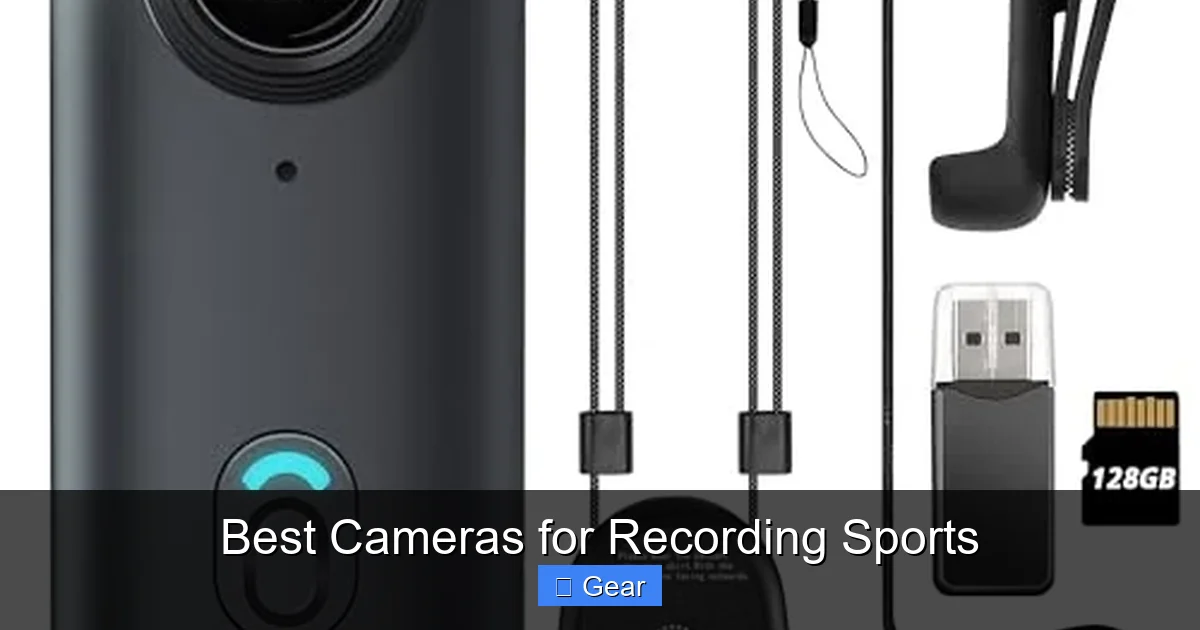
Visual guide about Best Cameras for Recording Sports
Image source: m.media-amazon.com
Now that we know what to look for, let’s explore the different types of cameras that excel in sports recording and highlight some fantastic options. When considering the best cameras for recording sports, it’s often a balance of budget, features, and portability.
Mirrorless Cameras: The Modern Powerhouses
Mirrorless cameras have largely taken over the professional sports world. They offer incredible autofocus speed, high frame rates, excellent image stabilization, and compact designs compared to DSLRs.
High-End Professional Mirrorless
These are the gold standard for serious sports videographers.
- Sony Alpha 1 (A1): Often hailed as one of the absolute best cameras for recording sports, the A1 boasts incredibly fast 30fps stills and 8K video, phenomenal autofocus with real-time tracking, and a robust professional build. Its low-light performance is also stellar.
- Canon EOS R3: Designed for pros, the R3 offers an amazing 24fps stills with electronic shutter, 6K raw video, and Canon’s renowned Dual Pixel AF, including Eye Control AF. It’s built like a tank and handles beautifully.
- Nikon Z9: A true professional workhorse, the Z9 offers 8K video without overheating, incredibly fast 20fps raw stills, and Nikon’s powerful 3D tracking AF system. Its ergonomics are fantastic for long shoots.
These cameras represent significant investments but deliver unparalleled performance.
Mid-Range Mirrorless Options
If the top-tier models are out of budget, these still offer fantastic sports capabilities.
- Sony Alpha a7 IV: A versatile hybrid camera with excellent 4K 60p video, a sophisticated autofocus system, and good low-light performance. It’s a fantastic all-rounder that handles sports very well.
- Fujifilm X-T5: While primarily a stills camera, the X-T5 offers excellent 6.2K video, robust build, and fast autofocus, making it a great choice for those who value image quality and a classic shooting experience.
DSLR Cameras: Tried and True Workhorses
While mirrorless cameras are gaining ground, many professional sports photographers and videographers still rely on DSLRs. They often have robust builds, familiar ergonomics, and access to a vast array of lenses.
Professional DSLRs
- Canon EOS-1D X Mark III: A legendary sports camera, known for its incredibly fast and reliable autofocus system, impressive high ISO performance, and excellent video capabilities (including 4K 60p). It’s built to withstand anything.
- Nikon D6: Nikon’s flagship DSLR, offering exceptional autofocus, phenomenal battery life, and outstanding low-light performance. It’s a beast in demanding environments.
DSLRs can still be some of the best cameras for recording sports, especially if you already own compatible lenses.
Action Cameras: Compact and Versatile
For unique perspectives, extreme sports, or when a large camera is impractical, action cameras are unbeatable.
- GoPro HERO12 Black: The king of action cameras. It offers up to 5.3K video at 60fps and 4K at 120fps, HyperSmooth 6.0 stabilization (which is truly incredible), and a rugged, waterproof design. Perfect for mounting on helmets, bikes, or getting those impossible-to-get angles.
- DJI Osmo Action 4: A strong competitor to GoPro, offering excellent image quality, great stabilization, and a unique magnetic quick-release system. Its low-light performance is particularly noteworthy for an action cam.
These are ideal for capturing first-person views or mounting in precarious spots to get dynamic, immersive footage.
Dedicated Camcorders: Simplicity and Zoom
While less common for pro sports recording these days, traditional camcorders still offer distinct advantages, primarily their long, optical zoom ranges and simplified operation.
- Panasonic HC-X2000 / Sony HXR-NX80: These professional-grade compact camcorders offer excellent optical zoom lenses, good low-light performance, and often come with built-in ND filters and XLR audio inputs. They are perfect for fixed-position recording where you need to zoom in on distant action without changing lenses.
Camcorders excel in situations where ease of use and extreme zoom are prioritized over absolute cinematic image quality.
Essential Accessories for Sports Recording
A camera body is just one part of the equation. To truly get the best sports footage, you’ll need a few key accessories.
The Right Lenses
This is huge. For sports, you’ll primarily need:
- Fast Telephoto Zoom Lenses: Think 70-200mm f/2.8, 100-400mm, or even super-telephoto primes (300mm f/2.8, 400mm f/2.8, 600mm f/4). The “fast” aperture (low f-number) is crucial for low-light performance and creating that beautiful blurred background (bokeh) that isolates the subject.
- Wide-Angle Lenses: For environmental shots, pre-game atmosphere, or capturing the full scope of a large play.
Stable Support: Tripods and Monopods
A good tripod or monopod is essential for steady, shake-free footage, especially with heavy telephoto lenses. A fluid head on your tripod is critical for smooth panning and tilting movements. Monopods offer greater mobility while still providing significant stability.
Ample Storage: Fast Memory Cards
Recording high-resolution, high-frame-rate video eats up storage quickly. You’ll need multiple high-capacity, high-speed memory cards (e.g., SDXC V90, CFexpress Type B) to keep up with the data rates and avoid buffering issues.
Power Solutions: Extra Batteries & Power Banks
Sports events can be long. Always carry at least two, preferably three, extra fully charged batteries. For action cameras, power banks that can charge them on the go are invaluable.
Audio Gear: External Microphones
While visuals are key, good audio adds so much to sports footage.
- Shotgun Microphones: Mount on your camera to pick up sound directionally from the action.
- Wireless Lavaliers: Great for interviews or capturing commentary from a coach or sideline reporter.
Even simple, higher-quality on-camera mics are a huge step up from built-in camera audio.
Tips for Capturing Amazing Sports Footage
Having the best cameras for recording sports is only half the battle. Your technique and understanding of the game are equally important.
Anticipate the Action
Sports are dynamic. Don’t just react; try to predict where the action is going next. Keep your eye on the ball, but also on the players off-ball. Pre-focus on key areas where action is likely to occur. This takes practice and a good understanding of the specific sport you’re filming.
Master Your Camera Settings
- Shutter Speed: A fast shutter speed (e.g., 1/500s or faster) is crucial for freezing fast action and avoiding motion blur. For video, aim for double your frame rate (e.g., 1/120s for 60fps footage) for a more cinematic look, but be prepared to increase it if motion blur is an issue.
- Aperture: Use a wider aperture (lower f-number) to create a shallow depth of field, blurring the background and making your subject pop. This also helps in low light.
- ISO: Keep ISO as low as possible to minimize noise, only increasing it when necessary for proper exposure, especially in low-light conditions.
- Manual White Balance: Set your white balance manually to ensure consistent color temperature, especially when light conditions are changing or if you’re dealing with mixed artificial lighting.
Composition and Framing
Don’t just point and shoot. Think about your shot.
- Rule of Thirds: Place your subject off-center for a more dynamic composition.
- Lead Room: Give moving subjects space to move into the frame, rather than having them right at the edge.
- Zoom Control: Use your zoom effectively. Don’t constantly zoom in and out. Frame your shot, let the action unfold, and then adjust if necessary.
- Vary Your Shots: Mix wide shots (to show the whole field), medium shots (group of players), and tight shots (individual athletes, close-ups of expressions).
Practice, Practice, Practice
Like any skill, sports videography improves with practice. Go to local games, experiment with settings, and review your footage critically. Learn from your mistakes and celebrate your successes.
Conclusion: Capture Every Thrilling Moment
Choosing the best cameras for recording sports is a significant step towards creating memorable and professional-looking footage. We’ve explored the essential features that make a camera excel in this demanding field: lightning-fast autofocus, high frame rates for smooth slow motion, robust image stabilization, strong low-light performance, and durable construction.
Whether you opt for a high-end mirrorless marvel like the Sony Alpha 1, a dependable DSLR workhorse, or a versatile action camera like the GoPro HERO12 Black, remember that the camera is just a tool. Pair it with the right lenses and accessories, master your settings, anticipate the action, and most importantly, practice. With the right gear and a passion for capturing the thrill of the game, you’ll be well on your way to creating stunning sports videos that truly bring the action to life. Get out there, start recording, and make every play count!
🎥 Related Video: ✅Top 5: Best Video Cameras For Sports in 2025 – The Best Video Cameras For Sports {Reviews}
📺 Gadgets Corner
Top 5: Best Video Cameras For Sports in 2025 – The Best Video Cameras For Sports {Reviews} Product Link : #ad” 1.
Frequently Asked Questions
What is the ideal frame rate for sports video?
For most sports, recording at 60 frames per second (fps) is an excellent baseline as it provides smooth motion and allows for modest slow-motion playback. For dramatic slow-motion effects, aim for 120fps or even higher, often at 1080p resolution, to capture every detail of fast-paced action.
Do I need an expensive camera for sports recording?
While professional-grade cameras offer superior performance, you don’t always need the most expensive gear to start. Mid-range mirrorless cameras and even some advanced action cameras can deliver excellent results, especially if paired with good lenses and proper shooting techniques. It’s about balancing features with your budget and specific needs.
How important is low-light performance for sports?
Low-light performance is incredibly important, as many sports events occur indoors under artificial lighting or outdoors during dusk or night. A camera with a larger sensor and good ISO capabilities will produce cleaner, less noisy footage in these challenging conditions, ensuring your videos remain crisp and clear.
Should I use a DSLR or Mirrorless camera for sports?
Modern mirrorless cameras generally offer advantages for sports recording due to their superior autofocus speed and tracking, faster burst rates, and often better in-body image stabilization. However, DSLRs still provide excellent results, especially professional models, and may be a more cost-effective option if you already own compatible lenses.
What role does the lens play in sports videography?
The lens is just as, if not more, important than the camera body for sports videography. A fast telephoto zoom lens allows you to capture distant action, isolate subjects with a shallow depth of field, and performs better in low light, all of which are crucial for high-quality sports footage.
How can I improve the audio quality of my sports videos?
To significantly improve audio quality, use an external microphone rather than the camera’s built-in one. A shotgun microphone mounted on the camera can capture directional sound from the action, while wireless lavalier microphones are ideal for capturing clear commentary or interviews from coaches or players.
