


Choosing between auto vs manual focus is a fundamental decision for any photographer, significantly impacting the final image. Autofocus excels in speed and convenience, ideal for capturing fast-moving subjects and ensuring sharp results quickly. Manual focus, conversely, offers unparalleled precision and creative control, perfect for challenging light, intricate compositions, or when you want specific parts of a scene tack-sharp. Understanding when and how to leverage each mode will dramatically improve your photography.
Welcome, fellow photography enthusiasts! Have you ever stared at a blurry photo, wondering what went wrong? Or perhaps you’ve felt frustrated by your camera’s inability to lock onto your subject? These common struggles often boil down to one critical camera function: focus. Specifically, the age-old debate of auto vs manual focus. It’s a topic that can spark lively discussions among photographers, much like debating Canon vs. Nikon or prime vs. zoom lenses. But fear not, we’re here to demystify it all.
Understanding when and how to use autofocus (AF) versus manual focus (MF) isn’t just about technical know-how; it’s about making deliberate creative choices that define your images. Both modes are incredibly powerful tools, each with its unique strengths and ideal applications. There’s no single “better” option; instead, it’s about knowing which tool to grab from your photographic toolbox for the job at hand. By the end of this article, you’ll have a clear understanding of the nuances of auto vs manual focus, empowering you to make smarter focusing decisions every time you pick up your camera.
So, grab a cup of coffee, settle in, and let’s explore the fascinating world of camera focus. We’ll break down how each system works, discuss their pros and cons, and arm you with practical tips and real-world examples to help you achieve tack-sharp images, no matter the situation. Whether you’re a beginner just learning the ropes or a seasoned pro looking to refine your technique, mastering auto vs manual focus is a skill that will profoundly impact the quality and artistry of your photographs.
Key Takeaways
- Autofocus (AF) is Fast and Convenient: Ideal for action, sports, wildlife, and candid shots where speed is paramount and subjects might be moving unpredictably.
- Manual Focus (MF) Offers Precision and Control: Perfect for situations demanding exact focus, like macro, landscape, astrophotography, or when shooting in very low light.
- Modern Cameras Aid Both Modes: Features like focus peaking and magnification tools make manual focusing much easier and more reliable, while advanced AF systems improve autofocus accuracy.
- Understand Your Scene: The best choice between auto vs manual focus often depends on the specific subject, lighting conditions, desired creative effect, and the overall pace of your shoot.
- Back Button Focus is a Game-Changer: This hybrid technique allows photographers to separate autofocus activation from the shutter button, offering a blend of AF speed and MF-like control.
- Practice is Essential: Mastering either auto or manual focus, and knowing when to switch, requires practice and familiarity with your camera’s focusing system.
Quick Answers to Common Questions
Which is faster, auto or manual focus?
Generally, autofocus is significantly faster than manual focus, especially with modern phase-detection systems, making it ideal for action and quick shots.
When should I always use manual focus?
You should always consider manual focus for macro photography, astrophotography, landscapes on a tripod, or in very low light conditions where autofocus struggles to lock.
Can I use both auto and manual focus on the same lens?
Yes, most modern lenses have a switch (AF/MF) to toggle between autofocus and manual focus. Some even allow for “full-time manual focus” override while in AF mode.
What is focus peaking?
Focus peaking is a visual aid, common in mirrorless cameras, that highlights the in-focus areas of your image on the screen with a bright color, making manual focusing much easier and more accurate.
Is back button focus a type of manual focus?
No, back button focus is a technique that separates autofocus activation from the shutter button, but it still utilizes your camera’s autofocus system. It provides a hybrid approach that gives you greater control over AF without fully switching to MF.
📑 Table of Contents
Understanding Autofocus (AF): The Speed Demon
Autofocus, often abbreviated as AF, is probably the mode most photographers start with and frequently rely on. It’s designed for speed and convenience, allowing your camera to automatically detect and adjust the lens elements to achieve sharp focus on a subject. Think of it as your camera doing the heavy lifting, quickly finding the sweet spot of sharpness so you can concentrate on composition and timing.
How Autofocus Works
Modern cameras primarily use two types of autofocus systems:
- Phase Detection Autofocus (PDAF): Found in most DSLRs and increasingly in mirrorless cameras, PDAF is very fast and accurate. It works by splitting the light coming from the lens into two images, comparing their phase, and determining exactly how much the lens needs to move and in what direction to achieve focus. This is why DSLRs can focus so quickly, especially on moving subjects.
- Contrast Detection Autofocus (CDAF): Common in older mirrorless cameras, compact cameras, and found in Live View mode on DSLRs, CDAF works by analyzing the contrast within the image. It moves the lens until it finds the point of highest contrast, which indicates sharpness. While generally very accurate, it can be slower than PDAF and might “hunt” back and forth a bit to find focus, especially in low light or on low-contrast subjects.
Many contemporary mirrorless cameras now employ hybrid autofocus systems that combine both phase and contrast detection, offering the best of both worlds: speed, accuracy, and broad coverage across the frame.
Advantages of Autofocus
The primary benefits of autofocus are undeniable:
- Speed: AF systems can lock focus in fractions of a second, crucial for capturing fleeting moments.
- Convenience: It frees you up to think about other aspects of photography, like composition and exposure, rather than constantly tweaking a focus ring.
- Good for Moving Subjects: Continuous autofocus (AF-C or AI Servo) is specifically designed to track subjects as they move, keeping them sharp.
- User-Friendly: For beginners, autofocus offers an accessible entry point into photography, ensuring a higher hit rate of sharp images from the get-go.
When to Use Autofocus
Autofocus shines in many scenarios:
- Sports and Action Photography: Absolutely essential for tracking fast-moving athletes, cars, or animals.
- Wildlife Photography: Whether a bird in flight or a deer dashing through the forest, AF-C is your best friend.
- Street Photography: Quick reactions are key, and autofocus allows you to capture candid moments before they disappear.
- Portraiture: Especially when working with active children or lively pets, AF helps ensure their eyes are sharp.
- Everyday Photography: For casual shots, snapshots, and general versatility, AF is incredibly reliable.
Understanding auto vs manual focus means knowing AF’s strengths.
Autofocus Modes and Settings
To get the most out of AF, familiarize yourself with your camera’s settings:
- Single-Shot AF (AF-S / One-Shot AF): Locks focus once and doesn’t change until you release and re-press the shutter. Ideal for stationary subjects.
- Continuous AF (AF-C / AI Servo AF): Continuously adjusts focus as long as the shutter button is half-pressed, perfect for moving subjects.
- Auto-Area AF (AF-A / AI Focus AF): The camera automatically switches between AF-S and AF-C based on whether the subject is moving.
- AF Points and Zones: Learn how to select specific AF points or zones to tell your camera exactly where to focus, rather than letting it guess. Eye-AF, for example, is a game-changer for portraits.
Mastering Manual Focus (MF): The Precision Artist
Visual guide about Auto Vs Manual Focus
Image source: i.ytimg.com
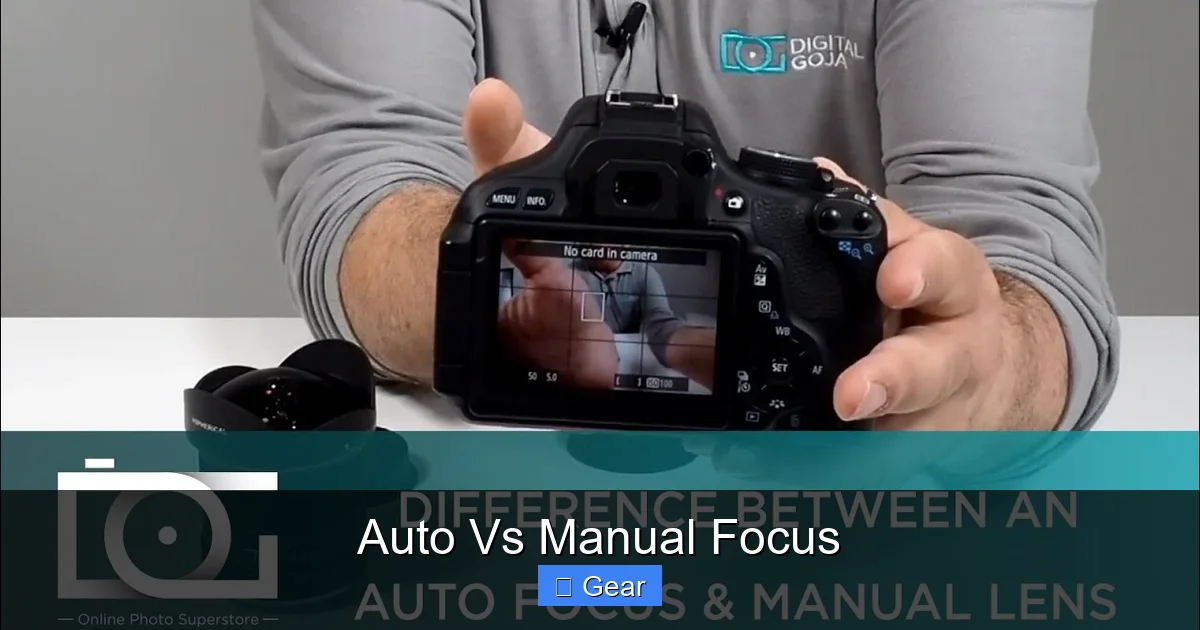
Manual focus, or MF, is where you, the photographer, take complete control. Instead of the camera making the focusing decisions, you physically turn the focus ring on your lens to bring your subject into sharp relief. While it requires more effort and practice, manual focus offers a level of precision and creative freedom that autofocus simply cannot match in certain situations.
How Manual Focus Works
With manual focus, there’s no complex electronic system detecting contrast or phase. It’s a purely mechanical or electronically assisted process. You look through the viewfinder or at the LCD screen and turn the focus ring on your lens until your subject appears sharp. This direct, tactile connection to your lens gives you an intimate understanding of your depth of field and composition.
Advantages of Manual Focus
The benefits of choosing manual focus over auto focus are compelling for specific types of photography:
- Pinpoint Precision: You can achieve exact focus on a tiny detail, something AF might struggle with. This is paramount for macro photography or highly specific compositions.
- Reliability in Challenging Conditions: Autofocus can “hunt” or fail entirely in very low light, on low-contrast subjects (like a white wall), or when shooting through obstructions. Manual focus bypasses these issues.
- Creative Control: MF allows for intentional soft focus, focus stacking, or focusing on an empty foreground to create artistic blur effects that AF might try to “correct.”
- No Hunting: Unlike AF, which can sometimes fail to lock and continuously search for focus, MF is always where you left it.
- Silent Operation: Essential for videography or sensitive environments, as there’s no motor noise from the lens.
When to Use Manual Focus
Manual focus truly shines when precision and control are prioritized:
- Macro Photography: Capturing tiny details requires extreme precision. AF often struggles with the shallow depth of field in macro.
- Landscape Photography: When using a tripod and taking your time, MF allows you to set focus precisely, often utilizing hyperfocal distance for maximum sharpness from front to back.
- Astrophotography: Focusing on distant, dim stars is nearly impossible for AF. MF is essential here.
- Portraits with Specific Focus: If you want to focus on an eyelash or a specific glint in the eye, MF gives you that control.
- Videography: Pulling focus smoothly and intentionally is a cornerstone of professional video production.
- Low Light Photography: When AF struggles to find contrast, MF can save the shot.
- Through Glass/Obstacles: AF can get confused by reflections or bars. MF lets you focus on your subject.
Techniques for Manual Focusing
Modern cameras have fantastic tools to aid manual focusing:
- Magnification/Zoom Assist: Most mirrorless cameras and DSLRs in Live View allow you to magnify the image on your screen, making it much easier to see critical sharpness.
- Focus Peaking: This brilliant feature (common in mirrorless cameras) highlights in-focus edges with a specific color, giving you a visual cue for sharpness.
- Hyperfocal Distance: For landscapes, understanding hyperfocal distance allows you to achieve maximum depth of field by focusing at a specific point.
- Tripod Use: For precise MF, especially in low light or macro, a sturdy tripod eliminates camera shake and allows you to fine-tune focus without hurry.
Auto Vs Manual Focus: A Direct Comparison
Now that we’ve explored each mode individually, let’s put auto vs manual focus head-to-head to better understand their fundamental differences and how they stack up in various scenarios.
Speed vs. Precision
This is the core of the auto vs manual focus debate. Autofocus is all about speed. It’s designed to lock onto a subject as quickly as possible, making it indispensable for action. Manual focus, on the other hand, is about ultimate precision. You might sacrifice a fraction of a second, but you gain the ability to place your focus exactly where you want it, down to the millimeter. Imagine trying to capture a bird in flight with MF – it’s incredibly difficult. Now imagine trying to perfectly focus on a single stamen of a flower in macro photography with AF – it’s equally challenging.
Convenience vs. Control
Autofocus offers unparalleled convenience. Point, shoot, and most of the time, you’ll get a sharp image. This makes it fantastic for casual shooting, family events, or when you just want to capture the moment without fuss. Manual focus demands more effort and attention. It requires you to actively engage with your camera and lens, giving you complete control over the focus point and depth of field, but at the cost of speed and ease. For some, this control is liberating; for others, it’s a hindrance.
Reliability vs. User Skill
Autofocus systems are incredibly reliable in good conditions. They rarely miss when there’s sufficient light and contrast. However, AF can “hunt” (search back and forth for focus) in low light, on reflective surfaces, or when there are obstacles between you and your subject. In these situations, AF can become unreliable. Manual focus, conversely, is always reliable, provided you have the skill to use it. It depends entirely on your ability to see and adjust for sharpness. With practice and the aid of modern focus assists, manual focus becomes incredibly dependable.
Lens Design and Cost
Lenses designed for autofocus typically incorporate complex motor systems (like stepping motors or ultrasonic motors) to move internal elements quickly and quietly. This often makes autofocus lenses more expensive than their manual-focus-only counterparts. Manual focus lenses, especially vintage ones, can be incredibly sharp and often more affordable, but lack the AF functionality. When considering auto vs manual focus, the gear you own plays a role.
Hybrid Approaches and Modern Tools
The world of photography isn’t always black and white, and neither is focusing. Many modern photographers blend both auto and manual focus techniques, using the best of both worlds to achieve optimal results. Cameras and lenses have evolved to support this versatility.
Back Button Focus (BBF)
This is arguably one of the most popular hybrid techniques. Back button focus decouples the autofocus activation from the shutter button. Instead of half-pressing the shutter to focus, you assign AF to a separate button on the back of your camera (e.g., AF-ON button).
How BBF Benefits You:
- Focus and Recompose: You can focus once with the back button, release it, and then recompose your shot without the camera trying to refocus every time you press the shutter.
- Seamless Switching: It allows you to quickly switch between continuous AF (for moving subjects, holding the button down) and effectively single-shot AF (for stationary subjects, pressing once) without changing modes.
- Instant MF: Once you’ve focused with the back button, you can fine-tune focus manually with the lens ring, effectively locking the AF. This is a great way to combine the speed of auto vs manual focus precision.
Focus Stacking
For macro or landscape photographers who need extreme depth of field, focus stacking is a technique that involves taking multiple images, each focused at a slightly different point, and then combining them in post-processing. While AF can sometimes be used for this, manual focus often offers greater control for precise focus increments, especially for the very small movements needed in macro.
Advanced Autofocus Systems
Modern cameras boast incredible AF capabilities:
- Eye-AF and Animal Eye-AF: These intelligent systems can detect and track eyes, ensuring tack-sharp focus on the most critical part of a portrait, even if the subject moves.
- Subject Tracking: Cameras can now identify and follow specific subjects (people, animals, vehicles) as they move through the frame, maintaining focus with impressive accuracy.
- Wide AF Coverage: Many mirrorless cameras offer AF points that cover almost the entire frame, giving you more flexibility in composition.
These advancements have certainly narrowed the gap, but still knowing when to engage auto vs manual focus remains crucial.
Focus Peaking and Magnification
As mentioned earlier, these in-camera aids are invaluable for manual focus. Focus peaking visually highlights sharp areas, while magnification lets you zoom into the precise point of focus on your screen. These tools make manual focusing more accessible and reliable than ever before, even for those new to the technique.
Making the Right Choice: Situational Awareness
The ultimate goal isn’t to declare one mode definitively superior to the other. Instead, it’s about developing the wisdom to choose the appropriate focus mode for each unique situation. This “situational awareness” comes from understanding your subject, your environment, and your creative intent. It’s truly about knowing the nuances of auto vs manual focus.
When AF is Your Best Friend:
- You’re shooting fast-paced action.
- You need to react quickly to unpredictable moments (street photography, candid shots).
- You’re capturing events where you can’t afford to miss a moment (weddings, sports).
- You’re hand-holding and moving, making precise manual adjustments difficult.
- The lighting is good, and your subject has clear contrast.
When MF Takes the Lead:
- You need absolute critical sharpness on a very specific point (macro, product photography).
- You’re working in very low light or on a low-contrast subject where AF struggles.
- You’re shooting through obstructions (a fence, glass with reflections).
- You’re on a tripod, composing carefully, and have time to fine-tune.
- You’re doing astrophotography or long exposure landscapes.
- You want specific creative effects like intentional soft focus or precise focus pulls in video.
Practice and Experimentation
The best way to master auto vs manual focus is to practice. Take your camera out and try shooting the same scene using both autofocus and manual focus. Pay attention to the results. Experiment with different AF modes, AF points, and MF assist features. The more you use them, the more intuitive the choice will become. Don’t be afraid to make mistakes; they are part of the learning process.
Conclusion
Deciding between auto vs manual focus is one of the foundational skills every photographer develops. There’s no single right answer, only the right answer for the specific moment you’re trying to capture. Autofocus offers unparalleled speed and convenience, making it the workhorse for many photographic genres. Manual focus provides ultimate precision and creative control, essential for those meticulous shots where every detail matters.
Modern camera technology has made both modes more powerful and user-friendly than ever before. With advanced AF systems, focus peaking, and back-button focus, photographers have a comprehensive toolkit at their disposal. The key is to understand the strengths and weaknesses of each, and then consciously choose the mode that best serves your artistic vision and the demands of your shooting situation. So go forth, experiment, and enjoy the journey of mastering focus! Your sharpest images await.
🎥 Related Video: Manual Focus Vs Auto Focus – Photography tips for beginners
📺 Photo Genius
Tips on how and when to use Manual Focus and Auto focus to help you get more from your digital camera and take better photos.
Frequently Asked Questions
What is the biggest advantage of autofocus?
The biggest advantage of autofocus is its incredible speed and convenience. It allows photographers to quickly acquire focus on subjects, particularly those that are moving, without having to manually adjust the lens, freeing them to concentrate on composition and timing.
Why would a professional photographer use manual focus?
Professional photographers often use manual focus for its unparalleled precision and creative control. This is crucial in genres like macro, astrophotography, and landscape photography where critical sharpness on specific elements is paramount, or when dealing with challenging light where AF might fail.
Does manual focus work better in low light?
Yes, manual focus often works better in very low light conditions because autofocus systems rely on detecting contrast, which is scarce when light is dim. Manual focusing, especially with the aid of magnification and focus peaking, allows you to deliberately set focus where AF would otherwise “hunt” or fail.
Are manual focus lenses cheaper than autofocus lenses?
Generally, dedicated manual focus lenses, particularly vintage ones, can be significantly cheaper than modern autofocus lenses because they lack complex internal motors and electronic components. However, high-quality, specialized manual focus lenses can still be quite expensive.
Can I override autofocus with manual focus?
Many modern autofocus lenses offer a “full-time manual focus” (FTM) override feature. This allows you to fine-tune focus manually by turning the focus ring even when the lens is set to autofocus, providing immediate micro-adjustments without needing to flip the AF/MF switch.
How does focus peaking help with manual focus?
Focus peaking is an invaluable tool for manual focus, especially for beginners. It works by detecting areas of highest contrast (which equate to sharp focus) in your image and outlining them with a bright, user-selectable color on your camera’s screen or electronic viewfinder, giving you an immediate visual confirmation of what is in focus.
