


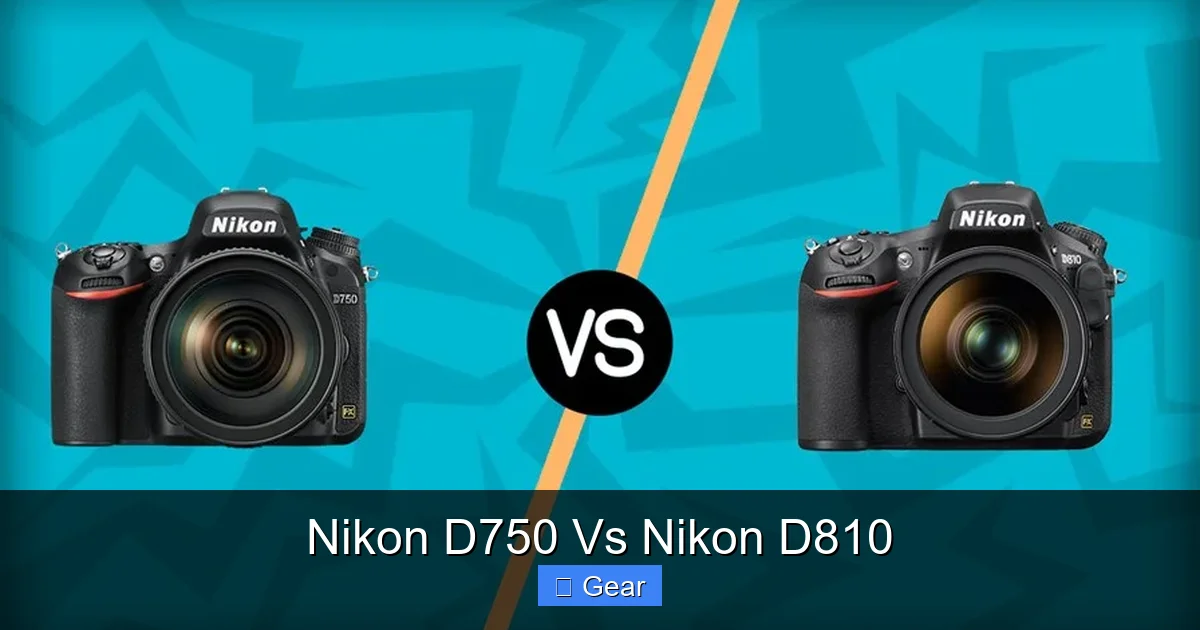
When comparing the Nikon D750 vs Nikon D810, you’re essentially choosing between speed and versatility versus ultimate resolution and refined image quality. The D750 shines with its advanced autofocus, better low-light performance, and tilting screen, making it a fantastic all-rounder. In contrast, the D810 offers a higher megapixel count for incredible detail, a base ISO of 64 for pristine landscapes, and a more robust build, ideal for studio and landscape pros.
Hey there, fellow photography enthusiast! Are you standing at a crossroads, pondering which legendary Nikon full-frame DSLR should be your next creative companion? You’re certainly not alone. The choice between the Nikon D750 vs Nikon D810 has been a subject of fervent discussion among photographers for years. These two powerhouses, released just a few months apart in 2014, represent slightly different philosophies within Nikon’s professional lineup, each offering compelling reasons to be in your camera bag.
On one side, we have the Nikon D750, a camera often lauded as a versatile workhorse, blending advanced features with a more accessible price point. It’s a camera that speaks to event photographers, portrait artists, and anyone needing exceptional low-light performance and a modern autofocus system. Then, we have the Nikon D810, a direct descendant of the high-resolution D800/D800E lineage, a true marvel for those who demand ultimate detail, pristine image quality, and robust construction. Think landscape pros, studio shooters, and commercial photographers who pixel-peep for a living.
This deep dive isn’t just about specs on a sheet; it’s about understanding how these specifications translate into real-world performance for your specific needs. We’ll break down everything from their sensors and autofocus to their build quality and video capabilities, giving you the clarity to make an informed decision. So, grab a coffee, and let’s unravel the intricate details of the Nikon D750 vs Nikon D810!
Key Takeaways
- Resolution vs. Low Light: The Nikon D810 boasts a 36.3MP sensor for maximum detail and a unique base ISO of 64, perfect for landscapes and studio work. The Nikon D750, with its 24.3MP sensor, offers superior high-ISO performance and cleaner images in challenging low-light conditions.
- Autofocus System: The D750 inherits a newer, more advanced 51-point Multi-CAM 3500FX II AF system with improved low-light sensitivity (-3EV) compared to the D810’s Multi-CAM 3500FX AF system (-2EV), giving the D750 an edge in tracking moving subjects and focusing in dim environments.
- Video Capabilities: Both cameras offer Full HD 1080p video, but the D750 includes a power aperture control during recording and a flat profile, making it slightly more versatile for videographers, along with a headphone port for audio monitoring.
- Ergonomics and Build: The D810 features a more traditional, robust magnesium alloy body, offering a very solid feel. The D750 utilizes a monocoque design with carbon fiber composite and magnesium alloy, resulting in a lighter body and includes a convenient tilting LCD screen, enhancing flexibility for various shooting angles.
- Speed and Buffer: The D750 offers a slightly faster continuous shooting speed at 6.5 frames per second (fps) compared to the D810’s 5 fps, along with a larger buffer capacity, making it more suitable for action and sports photography.
- Price and Value: Typically, the Nikon D750 is more budget-friendly, especially on the used market, offering exceptional value for its performance. The D810, while older, still commands a price reflecting its professional-grade resolution and build.
Quick Answers to Common Questions
Are the Nikon D750 and D810 full-frame cameras?
Yes, both the Nikon D750 and Nikon D810 are full-frame (FX-format) DSLR cameras, meaning they have sensors the same size as a 35mm film frame.
Which camera is better for low-light photography, the D750 or D810?
The Nikon D750 is generally better for low-light photography due to its 24.3MP sensor, which has larger photosites and produces cleaner images at higher ISOs, combined with a more sensitive autofocus system.
Does the Nikon D810 have a tilting screen?
No, the Nikon D810 has a fixed LCD screen. The tilting screen is a feature exclusive to the Nikon D750 among these two models.
Which camera has higher megapixels?
The Nikon D810 has a higher megapixel count at 36.3MP compared to the Nikon D750’s 24.3MP.
Do both cameras have built-in Wi-Fi?
No, only the Nikon D750 has built-in Wi-Fi for easy image transfer and remote control. The Nikon D810 requires an optional accessory for wireless connectivity.
📑 Table of Contents
- Sensor and Image Quality: Resolution vs. Low Light Prowess
- Autofocus System: Precision and Speed in Action
- Video Capabilities: More Than Just Stills
- Build Quality and Ergonomics: Handling and Durability
- Speed and Performance: Catching the Moment
- Other Key Features and Practical Considerations
- Which One is Right for You? Making Your Choice
Sensor and Image Quality: Resolution vs. Low Light Prowess
This is often where the biggest distinction lies when comparing the Nikon D750 vs Nikon D810. It’s a classic battle between sheer resolution and high-ISO performance.
Nikon D810: The Resolution King
The Nikon D810 boasts a whopping 36.3-megapixel full-frame FX-format CMOS sensor. What’s truly special about this sensor is that it operates without an optical low-pass filter (OLPF), just like its D800E predecessor. This absence allows the sensor to capture an incredible amount of fine detail, making images from the D810 truly breathtaking, especially when printed large or cropped significantly. For landscape photographers, architectural shooters, or anyone doing meticulous product photography in a studio, this level of detail is a massive advantage. Imagine capturing every leaf on a distant tree or the subtle texture of a fabric – that’s the D810’s playground.
Another unique feature of the D810’s sensor is its native base ISO of 64. Most cameras start at ISO 100, but dropping down to ISO 64 means even less noise in your images and a wider dynamic range in bright conditions. This is fantastic for capturing vibrant colors and subtle tonal transitions without blowing out highlights, especially useful in bright daylight scenarios where you want maximum image purity. It allows you to use wider apertures in bright light without overexposing, leading to beautiful bokeh. However, this high resolution can also mean larger file sizes, requiring more storage and processing power.
Nikon D750: The Low-Light Champion
On the other side, the Nikon D750 comes equipped with a 24.3-megapixel FX-format CMOS sensor. While 24.3MP might seem less impressive than 36.3MP, don’t let the numbers fool you. Fewer megapixels on the same size sensor often mean larger individual photosites (pixels), which are more efficient at gathering light. This translates directly into superior high-ISO performance. The D750 produces noticeably cleaner images at higher ISOs, making it a dream for wedding photographers capturing dimly lit receptions, event photographers working indoors, or anyone shooting astrophotography.
The D750’s sensor also features an optical low-pass filter, which helps to mitigate moiré patterns. While this might slightly reduce the absolute finest detail compared to the D810, for most real-world shooting, the difference is negligible and often beneficial. The D750’s dynamic range is also excellent, allowing you to recover a lot of detail from shadows and highlights in post-processing. Its balance of resolution and low-light capability makes it incredibly versatile.
Autofocus System: Precision and Speed in Action
A camera’s autofocus system is its eye, and a good one can make or break a shot, especially when comparing the Nikon D750 vs Nikon D810 in dynamic scenarios.
Visual guide about Nikon D750 Vs Nikon D810
Image source: thenewcamera.com
Nikon D750: The Modern AF Performer
The Nikon D750 truly shines in its autofocus capabilities. It features Nikon’s advanced Multi-CAM 3500FX II AF sensor module, which is a significant upgrade from the D810’s system. This 51-point system includes 15 cross-type sensors for enhanced accuracy and is sensitive down to an impressive -3 EV (Exposure Value). What does -3 EV mean for you? It means the D750 can lock focus in extremely dim lighting conditions – think candlelight or a poorly lit indoor venue – where other cameras might hunt and struggle. This makes it an absolute workhorse for wedding, event, and street photographers who often find themselves in challenging light.
The D750 also offers Group Area AF mode, which effectively uses five AF points as a single block. This is incredibly useful for tracking erratically moving subjects, like children playing or birds in flight, helping to maintain focus even if the subject briefly moves out of the primary AF point. Its speed and accuracy in varied light conditions give it a noticeable edge for action and candid photography.
Nikon D810: Reliable and Refined
The Nikon D810 uses the Multi-CAM 3500FX AF sensor module, the same system found in the D4S and D800. It’s a 51-point system with 15 cross-type sensors and is sensitive down to -2 EV. While still very capable and reliable, it’s a step below the D750’s system in terms of extreme low-light performance. In most well-lit to moderately dim conditions, the D810’s autofocus is fast, accurate, and perfectly sufficient for a wide range of subjects, including portraiture, landscape, and studio work.
For subjects that aren’t moving too quickly or in extremely low light, the D810’s AF system is precise and dependable. However, if you frequently shoot in very dark environments or need to track fast, unpredictable subjects, you’ll likely notice the D750’s advantage. The D810 also benefits from Nikon’s 3D Tracking, which works well for maintaining focus on a subject moving towards or away from the camera, even if the composition changes.
Video Capabilities: More Than Just Stills
In today’s hybrid shooting world, video features are increasingly important. Let’s see how the Nikon D750 vs Nikon D810 stack up.
Nikon D750: Videographer-Friendly Features
The Nikon D750 offers a strong suite of video features for its time. It can record Full HD 1080p video at various frame rates up to 60p (50p for PAL regions). One of its standout features for videographers is the inclusion of a power aperture control during live view and video recording. This allows you to smoothly adjust the aperture using dedicated buttons while recording, avoiding the clicks and sudden changes often associated with adjusting the aperture ring on a lens. This is a huge benefit for achieving seamless exposure transitions.
Additionally, the D750 introduced a “Flat” Picture Control profile, which provides a flatter, more neutral starting point for your video footage. This profile retains more detail in highlights and shadows, giving you greater flexibility for color grading and post-production work. It also has a headphone jack for audio monitoring and can output uncompressed video via HDMI, making it a very capable tool for serious videographers. The tilting screen also aids greatly in achieving creative angles for video.
Nikon D810: Solid Full HD Foundation
The Nikon D810 also offers Full HD 1080p video recording, with frame rates up to 60p (50p for PAL regions). Its video quality is excellent, leveraging that incredibly detailed sensor. You’ll get crisp, clean footage with beautiful colors. It also includes manual control over exposure, a dedicated movie shooting menu, and a microphone input, allowing for external audio recording.
However, compared to the D750, the D810 lacks the power aperture control during recording and the “Flat” Picture Control profile. While you can still achieve great results, you might find yourself doing a bit more work in post-production to achieve the desired look or dealing with slight exposure shifts if you adjust aperture mid-shot. It’s a very capable video camera for capturing high-quality footage, but the D750 offers a few more creature comforts specifically designed for videographers.
Build Quality and Ergonomics: Handling and Durability
How a camera feels in your hands and how well it stands up to the elements is crucial, especially for professionals. Let’s compare the physical aspects of the Nikon D750 vs Nikon D810.
Nikon D810: Robust and Traditional
The Nikon D810 is built like a tank, with a full magnesium alloy body that feels incredibly solid and robust. It’s a professional-grade camera designed to withstand the rigors of daily professional use. It features extensive weather sealing, providing excellent protection against dust and moisture, which is essential for outdoor and adventure photographers. The grip is deep and comfortable, offering a secure hold even with larger lenses. All the buttons and dials are well-placed, intuitive, and have a satisfying tactile feel, adhering to Nikon’s traditional control layout.
Weighing in at approximately 880g (body only), it’s a substantial camera that feels balanced with pro lenses. Its fixed LCD screen is bright and sharp, though not offering the same flexibility as a tilting one. If you prioritize maximum durability and a very traditional, professional feel, the D810 definitely delivers.
Nikon D750: Innovative and Lighter
The Nikon D750 takes a slightly different approach to its construction. It uses a monocoque (single-shell) design, combining carbon fiber composite for the front body and magnesium alloy for the rear cover. This innovative construction allows the D750 to be significantly lighter than the D810, weighing around 750g (body only), making it more comfortable for extended shooting sessions or travel. While still very durable and weather-sealed, some might perceive it as slightly less “rugged” than the all-magnesium D810, though in practice, its weather sealing is very effective.
The D750’s grip is also deep and comfortable, arguably even slightly more contoured and ergonomic for some hands. The biggest ergonomic differentiator is its 3.2-inch tilting LCD screen. This feature is incredibly useful for shooting from low or high angles, making it easier to compose shots without having to contort yourself. This is a huge benefit for videographers, street photographers, and anyone who enjoys creative perspectives. It might not be as rock-solid as the D810, but its lighter weight and tilting screen offer tangible practical advantages.
Speed and Performance: Catching the Moment
When it comes to capturing fast-moving subjects or critical moments, continuous shooting speed and buffer depth are key. Let’s compare the speed aspects of the Nikon D750 vs Nikon D810.
Nikon D750: The Agile Shooter
The Nikon D750 is the speed demon of the two. It boasts a continuous shooting speed of 6.5 frames per second (fps) at full resolution. This makes it a more suitable choice for sports, wildlife, and fast-paced event photography where capturing the decisive moment is paramount. The D750 also features a larger buffer, allowing you to shoot more frames in a burst before the camera slows down. This combination of faster burst speed and deeper buffer makes it incredibly responsive and capable of handling action with ease.
Its EXPEED 4 image processing engine is efficient, ensuring quick image processing and generally snappy camera operation. While not a D5 or D6, for its class, the D750 offers excellent speed for a wide variety of photographic genres.
Nikon D810: Precise and Steady
The Nikon D810, with its higher resolution sensor, offers a continuous shooting speed of 5 frames per second (fps) at full resolution. This speed is perfectly adequate for many forms of photography, including portraiture, landscape, and slower-paced events. However, for fast action, 5 fps might feel a bit slow compared to the D750’s 6.5 fps.
The D810 uses the EXPEED 4 image processing engine as well, ensuring quick image processing for its larger files. While its buffer isn’t as deep as the D750’s, it’s still capable of handling a good number of RAW files before slowing down. The D810’s emphasis is less on blazing speed and more on delivering exceptionally detailed images with precision, making it more suited for scenarios where resolution is prioritized over raw speed.
Other Key Features and Practical Considerations
Beyond the core specs, several other features can influence your decision when looking at the Nikon D750 vs Nikon D810.
Connectivity and Storage
Both cameras feature dual SD card slots, offering flexibility for backup, overflow, or separating RAW and JPEG files. The D750 includes built-in Wi-Fi, allowing for seamless image transfer to smart devices and remote camera control, which is incredibly convenient for quick sharing or studio setups. The D810, however, lacks built-in Wi-Fi and requires an optional WU-1a or WT-5a wireless transmitter for similar functionality. This is a clear modern convenience advantage for the D750.
Battery Life
The D750 uses the EN-EL15 battery, which offers an impressive CIPA rating of around 1,230 shots per charge, thanks to its efficient power management. The D810 also uses the EN-EL15 battery but achieves an even higher CIPA rating of approximately 1,200 shots per charge. Both offer excellent battery life for a full-day shoot, but the D750’s slightly higher efficiency is a small win.
Viewfinder and Displays
Both cameras feature bright optical viewfinders with 100% frame coverage, providing a clear and immersive shooting experience. The D750, as mentioned, has a tilting 3.2-inch LCD, while the D810 has a fixed 3.2-inch LCD. The tilting screen on the D750 is a huge advantage for creative angles and video work, allowing for much more comfortable shooting from diverse perspectives.
Shutter Mechanism
The D810 boasts a refined shutter and mirror box mechanism, incorporating an electronic front-curtain shutter option. This minimizes vibrations, which is crucial for maximizing the sharpness of those 36.3MP images, especially when using a tripod. The D750’s shutter is also excellent but doesn’t have the same electronic front-curtain option. For critical landscape or studio work where absolute sharpness is key, the D810’s shutter design offers a subtle but important advantage.
Which One is Right for You? Making Your Choice
So, after breaking down the Nikon D750 vs Nikon D810, which camera should you choose? It truly boils down to your primary shooting style and priorities.
Choose the Nikon D750 if:
- You frequently shoot in low-light conditions (weddings, events, concerts, astrophotography).
- You need superior autofocus performance for tracking moving subjects.
- You value a tilting LCD screen for creative angles and video work.
- You require faster continuous shooting for action or sports.
- You want built-in Wi-Fi for easy sharing and remote control.
- You’re looking for a lighter, more ergonomic camera for extended use or travel.
- You prioritize value and versatility without needing extreme resolution.
Choose the Nikon D810 if:
- You demand the absolute highest resolution and image detail for large prints or significant cropping.
- You primarily shoot landscapes, architecture, or studio/product photography where detail and dynamic range at base ISO are paramount.
- You want the cleanest possible images at base ISO 64.
- You prefer a robust, all-magnesium alloy build and don’t need a tilting screen.
- You value a refined shutter mechanism that minimizes vibrations for maximum sharpness.
- You’re often shooting in controlled lighting environments where extreme low-light AF isn’t a primary concern.
In conclusion, both the Nikon D750 and Nikon D810 are exceptional full-frame DSLRs that represent the pinnacle of Nikon’s engineering from their era. The D750 is the modern, versatile all-rounder, excelling in dynamic situations and low light with its advanced AF and ergonomic features. The D810 is the uncompromising resolution king, a detail-gathering machine for those who cherish every pixel and demand the purest image quality. Your decision will ultimately come down to which of these strengths aligns best with your photographic vision and practical shooting needs. Whichever you choose, you’ll be getting a truly fantastic camera capable of producing stunning imagery.
🎥 Related Video: Nikon D810 vs D750 Comparison | 20+ Similarities & Differences
📺 About Camera
Welcome to the About Camera channel. In this episode we will be talking about the comparison of Nikon D810 vs Nikon D750.
Frequently Asked Questions
Is the Nikon D750 a professional camera?
Absolutely. While often considered a step below Nikon’s flagship D800-series or Dx models, the D750 offers a professional-grade full-frame sensor, advanced autofocus, excellent build quality, and a comprehensive feature set that makes it a highly capable tool for professional photographers in many fields, including weddings, events, and portraits.
Which camera is heavier, the D750 or D810?
The Nikon D810 is heavier than the D750. The D810 weighs approximately 880g (body only) due to its full magnesium alloy construction, whereas the D750, with its carbon fiber composite and magnesium alloy monocoque design, is lighter at around 750g (body only).
Can I use the same lenses on both the D750 and D810?
Yes, since both the Nikon D750 and D810 are full-frame (FX-format) Nikon F-mount cameras, they share the same lens mount. This means you can use the vast majority of Nikon’s FX and DX (though DX lenses will result in cropping) lenses on either camera body.
Which camera has better battery life?
Both cameras offer excellent battery life with the EN-EL15 battery. The Nikon D750 has a CIPA rating of approximately 1,230 shots per charge, while the Nikon D810 is rated for around 1,200 shots per charge, making them both highly efficient for extended shooting.
Does the D810 have an optical low-pass filter (OLPF)?
No, the Nikon D810, like its predecessor the D800E, does not have an optical low-pass filter (OLPF). This design choice allows its 36.3MP sensor to capture maximum sharpness and fine detail, though it can theoretically increase the risk of moiré patterns in certain situations.
Which camera is better for video recording?
While both cameras record excellent Full HD video, the Nikon D750 has a slight edge for videographers. It offers power aperture control during recording for smooth exposure adjustments, a “Flat” Picture Control profile for easier color grading, and a headphone jack for audio monitoring, making it more feature-rich for video production.
